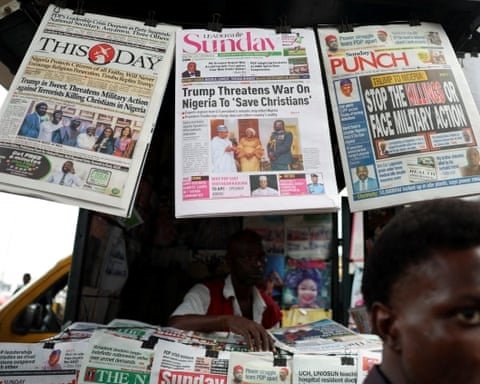
U.S. President Donald Trump has threatened potential military intervention in Nigeria, declaring he would go in “guns-a-blazing” if the West African nation fails to stop attacks against Christians. The warning came in a social media post where he accused radical Islamists of carrying out mass slaughter and vowed to cut all American aid if the violence continues.
The president’s statement follows sustained pressure from conservative Christian groups and lawmakers urging the administration to designate Nigeria as a country of particular concern for religious persecution. This reflects ongoing political calculations to appeal to evangelical voters who prioritize international religious freedom issues.
Nigeria’s complex security landscape defies simple religious categorization. While the country is roughly split between Muslims and Christians, the violence stems from multiple sources. In central regions, conflicts between nomadic herders and farming communities are primarily driven by competition over land and water resources, though religious differences often intensify tensions.
Multiple armed groups operate across different regions with varying motivations. In the northeast, Islamist insurgents continue their deadly campaign, while northwestern states face rampant banditry that affects both Muslim and Christian communities. Criminal elements increasingly target religious leaders for kidnapping, seeing them as valuable assets for ransom payments rather than religious targets.
Nigerian officials have responded cautiously to the American threats. President Bola Tinubu’s administration emphasized the country’s constitutional protections for religious freedom while avoiding direct confrontation. His spokesperson characterized the situation as a “miscommunication” that could be resolved through dialogue, while firmly stating that any foreign military action would require Nigerian government cooperation.
The escalating rhetoric raises concerns about the future of U.S.-Nigeria relations, particularly regarding security assistance and arms sales. Previous American military support has been restricted due to human rights concerns involving Nigerian security forces.
Security analysts note that Nigeria’s government faces immense challenges containing multiple security crises simultaneously. With state presence weak in many regions, vigilante groups have emerged to fill security gaps, creating additional complications for governance and stability.