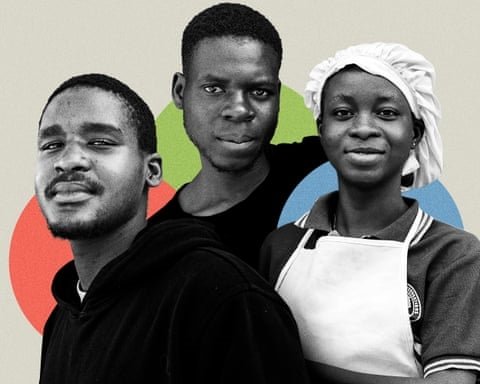
Twenty years after a major international news project documented the births of ten babies across Africa, a follow-up reveals the complex realities facing a generation defined by both hardship and resilience. The initial project aimed to chronicle the lives of children born as world leaders set ambitious global development targets.
Today, with many of those goals unmet, the paths of these young adults reflect the continent’s persistent challenges—from economic stagnation to youth unemployment—alongside powerful stories of personal perseverance.
Innocent Smoke: Seeking Stability in Malawi
In Mponela, a small agricultural town near Malawi’s capital, Innocent Smoke shares a single rented room with his wife and infant son. The brick-and-cement structure is an improvement over the thatched hut of his childhood, though it lacks running water and electricity.
A certified motorcycle mechanic, Innocent has pieced together a living through various jobs—from factory work to security—and now tests materials for a Chinese road construction company. His dream of opening his own garage remains out of reach.
“We were devastated when we lost our first child,” he says, reflecting on the infant mortality that remains high in Malawi. “But we found strength in faith.” Their second son, Israel, now fills their home with joyful noise.
Innocent’s concerns are practical: job security and the rising cost of living. “Losing work is terrifying when you have a family to support,” he notes. Like many young Malawians, he sees limited opportunities in an economy historically dependent on tobacco, now facing global decline. He recently voted in presidential elections, hoping for leadership that will “create companies that employ people so we can reduce poverty.”
Hannah Adzo Klutsey: Redefined Dreams in Ghana
In a makeshift bakery outside Accra, 19-year-old Hannah Adzo Klutsey layers buttercream on cakes—a far cry from her childhood ambition of becoming a doctor. “Life pushed me here,” she says, wiping flour from her hands.
After struggling academically in junior high school, Hannah entered a baking apprenticeship. She divides her time between the bakery and her family home in Sapeiman, where she helps with household chores.
Despite Ghana’s status as a leading gold and cocoa producer, the country faces significant economic challenges. Many households struggle with high inflation, and poverty rates are projected to increase.
Hannah battles chronic health issues without access to proper medical care, relying on pharmacy painkillers and herbal remedies. She shares cramped sleeping quarters with two other apprentices in a metal container without water or toilet facilities.
Yet she remains optimistic about her future. “While my peers await exam results, I’ll soon open my own shop,” she says proudly. Her father, Benjamin, acknowledges the financial strain of her apprenticeship but supports her path forward.
Angel Siyavuya Swartbooi: A Second Chance in South Africa
Angel Siyavuya Swartbooi, known as Siya, recently celebrated one month of sobriety after completing rehabilitation. “I’m not trying to stop,” he says firmly. “I stopped.”
His family moved to the township of Mfuleni to escape the crime and drugs prevalent in their previous Khayelitsha neighborhood. They now share a nine-square-meter room that, while small, represents safety and stability.
Siya’s mother, Nonzuzo, recalls when she realized her son had a problem. “He’d skip school and make excuses,” she says. The situation culminated earlier this year when police took him to the hospital after concerning behavior.
After three months in rehabilitation—which Siya describes as surprisingly “fun”—he’s now focused on his future. He hopes to train as an electrician, recognizing that “there are opportunities in South Africa, but you need a skill.”
Nonzuzo remains cautiously optimistic, encouraging him to join a gym and consider vocational courses. She dreams of moving the family to better housing but takes comfort in a Xhosa proverb displayed in their home: “An elephant is not burdened by its trunk”—meaning one should not be overwhelmed by their responsibilities.
These three lives, scattered across different nations, reflect both the unfulfilled promises of international development goals and the enduring human capacity for hope and adaptation in the face of adversity.