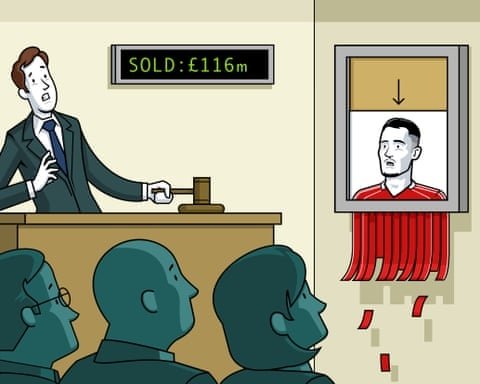
The weight of a massive transfer fee can be the single greatest obstacle for a young footballer. While the talent is often undeniable, history suggests that when a club spends over £80 million, the odds of success are stacked against the player.
The evidence is stark. A review of the most expensive transfers reveals a graveyard of unfulfilled potential. For every Jude Bellingham, whose move to Real Madrid has been a triumph, there are multiple high-profile failures. Gareth Bale and Harry Kane are among the few in the top tier of fees who delivered a clear return on the investment. More common are cautionary tales like Eden Hazard’s stint in Madrid, which saw a fortune exchanged for minimal impact, or Neymar’s move to Paris Saint-Germain, a deal that warped the market itself.
The problem is multifaceted. An exorbitant price tag is not just a number; it creates an immediate and intense pressure cooker. It establishes an internal hierarchy before a ball is kicked and sets expectations that are often unrealistic. This money is also capital that is then unavailable to strengthen other areas of the squad, creating a lopsided team structure.
For a creative attacker under the age of 23, the challenge is even more acute. The list of those who have successfully transitioned to a stronger league for a nine-figure sum is vanishingly short. Many have faltered, unable to adapt to the heightened physicality, speed, and tactical demands. They arrive as promising talents but are immediately judged as finished products.
The player in question is undoubtedly gifted—a technically superb, nimble midfielder with a creative spark. However, he is being asked to adapt his game significantly. He is moving from a system where he was the focal point of every attack to one that is still finding its new identity. Furthermore, he enters a league that is increasingly defined by power, relentless running, and set-pieces, phases of the game where his specific skills may have less influence.
The core issue is not his ability, but the context. A €60 million signing can be afforded patience; he can be rotated and developed. A €125 million signing is denied that luxury. He must perform from the start under the brightest lights, often miscast by his own price tag. He becomes a symbol of a club’s ambition and, at times, its desperation—a young man carrying his delicate talents directly into a high-stakes environment where the margin for error is zero. The machinery of modern football demands instant returns, and history shows that for most, the weight of the fee proves too heavy to bear.