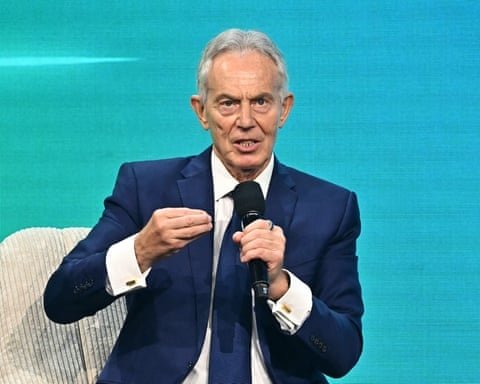
Former British Prime Minister Tony Blair has reemerged in Middle Eastern diplomacy, participating in White House discussions about Gaza’s postwar governance alongside Trump administration officials and regional allies. The planning sessions notably exclude Palestinian representation despite focusing on determining Gaza’s political future.
The closed-door meetings involve Blair collaborating with Donald Trump’s son-in-law Jared Kushner, Israeli Minister for Strategic Affairs Ron Dermer, and Emirati Foreign Minister Abdullah bin Zayed. While reports indicate Palestinian President Mahmoud Abbas received briefings, there appears to be minimal substantive Palestinian involvement in the decision-making process.
Palestinian civil society leaders have expressed strong objections to this exclusionary approach. Ubai Al-Aboudi of the Bisan Center for Research and Development described the process as “colonial practice” that denies Palestinian self-determination while genocide continues. He emphasized that Palestinians have developed their own comprehensive vision for postwar governance that reflects their historical, cultural, and socioeconomic context.
The Palestinian civil society proposal, backed by Arab League and European support, calls for rebuilding Gaza under Palestinian Authority management with eventual elections leading to unification with the West Bank. This approach prioritizes Palestinian agency and addresses the refugee status of approximately 80% of Gaza’s population, whose families were displaced in 1948.
Current discussions occur against a backdrop of increased pressure on Palestinian civil society organizations. In 2021, Israel designated several human rights groups, including Al-Aboudi’s Bisan Center, as terrorist organizations—a move widely criticized by international observers.
Despite these challenges, Palestinian civil society continues advocating for self-determination. Al-Aboudi noted that global solidarity movements provide hope, affirming that “righteousness is on our side” and that political agency ultimately resides with the people rather than external powers or compromised leadership.
The exclusion of Palestinian voices from planning their future represents a continuation of decades-long patterns that civil society leaders argue must be fundamentally reconsidered in light of current circumstances.