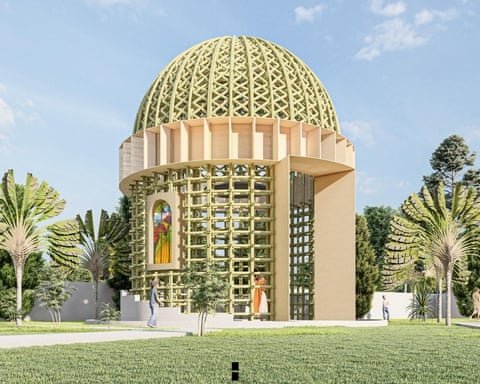
A striking 15-meter bamboo pavilion now towers over the Iyekogba neighborhood in Benin City, signaling the arrival of Nigeria’s first Black Muse arts festival and the opening of a significant new sculpture park. The domed structure, designed by acclaimed architect James Inedu-George, serves as the centerpiece of a 3,500-square-meter landscaped art space that celebrates the region’s deep artistic heritage while introducing contemporary art to broader audiences.
The visionary behind this cultural initiative is artist Victor Ehikhamenor, who acquired the property fifteen years ago with the dream of establishing an artistic hub in his childhood region. “This represents a personal commitment to developing Nigeria’s cultural infrastructure,” Ehikhamenor stated, noting his previous establishment of the nearby Black Muse Residency for artists.
The park’s opening coincides with several major cultural developments in Benin City, including the forthcoming Museum of West African Art scheduled to open later this month on a sprawling 6-hectare campus.
Inedu-George’s architectural design draws inspiration from ancient bronze artifacts while incorporating traditional Nigerian bamboo construction techniques. The pavilion features stained-glass elements that acknowledge the city’s Christian heritage, home to one of Nigeria’s oldest churches, the 16th-century Holy Aruosa Cathedral.
Artistic continuity forms a central theme of the project, connecting contemporary practices with the Benin kingdom’s historic bronze craftsmanship. “We’re building upon the legacy of pioneering Nigerian artists who established independent institutions,” Ehikhamenor explained. “This creates a permanent space for artistic experimentation and public engagement with art in natural surroundings.”
The park’s landscape design emphasizes environmental consciousness, featuring indigenous plants that hold both ecological and spiritual significance. “Urban development shouldn’t come at the expense of green spaces,” Ehikhamenor emphasized. “We can integrate art and nature in our cities.”
The inaugural festival, titled “Let the Forest Dance,” includes an exhibition curated by Kenyan cultural producer Renée Akitelek Mboya, showcasing works by emerging and established West African artists. The programming extends to educational outreach, with free admission, guided tours for schools, and community workshops.
Festival events span multiple artistic disciplines, featuring performances, literary readings, bronze-casting demonstrations, film screenings, and musical concerts. Organizers have emphasized the event’s accessibility, describing it as a grassroots gathering open to all community members.
“This festival invites everyone—families, students, craftspeople—to experience art not as something exclusive but as an integral part of daily life,” Ehikhamenor said. “It’s an open invitation to engage with the creative energy of our era.”