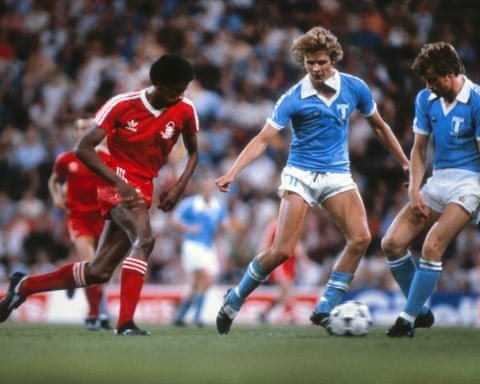
An English manager’s tactical revolution in Sweden nearly culminated in one of football’s greatest underdog triumphs. Bob Houghton, then just 26 years old, transformed Malmö FF’s approach and guided them to the 1979 European Cup final against Nottingham Forest.
The Swedish side’s journey to Munich’s Olympic Stadium represented a remarkable achievement for a squad featuring numerous part-time players. Team members balanced football with careers ranging from engineering to sales management, with midfielder Claes Malmberg even maintaining his position as Toshiba’s sales manager throughout their European campaign.
Houghton introduced radical changes upon his 1974 arrival, implementing a back four, zonal marking, and direct football philosophy that broke from Swedish football’s traditional German-influenced systems. His methods initially surprised players accustomed to conventional preseason running routines, but quickly produced results with consecutive league titles in 1974 and 1975.
The European campaign showcased Houghton’s meticulously organized defensive system. Players describe training sessions focused heavily on defensive repetition and collective responsibility. “Every metre, every centimetre, we knew exactly our position,” recalled Malmberg, emphasizing the team’s tactical discipline.
Malmö navigated past Monaco, Dynamo Kyiv, Wisla Krakow, and Austria Wien to reach the final, with forward Jan-Olov Kindvall scoring crucial away goals. Their Munich showdown against Brian Clough’s Nottingham Forest nearly produced a stunning early breakthrough when Kindvall found space behind Kenny Burns, only to see his attempted lob comfortably collected by goalkeeper Peter Shilton.
The final proved particularly challenging as Malmö faced the match without three key injured players, including captain Staffan Tapper and star midfielder Bo Larsson. Despite these setbacks, they maintained their defensive organization against a Forest side featuring England’s first million-pound footballer, Trevor Francis, who ultimately scored the decisive goal.
Reflecting on their near-miss, Kindvall acknowledged that scoring first might have changed the match’s dynamic, while emphasizing the uniqueness of their achievement. For a team comprised largely of local players with only five full-time professionals to reach European football’s pinnacle event remains one of the competition’s most improbable stories.