
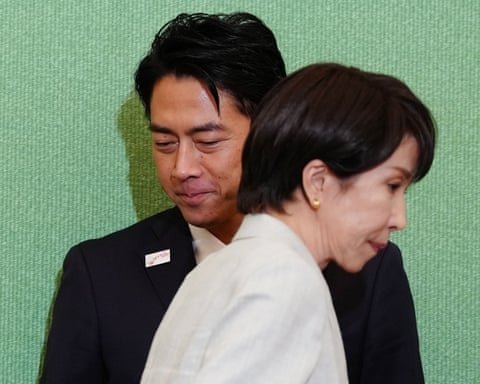
Two leading contenders have emerged in the race to lead Japan’s ruling Liberal Democratic Party, with the party preparing to select its new leader next week. The outcome will determine whether Japan gets its first female prime minister or its youngest postwar leader, though the symbolic importance of either milestone may be overshadowed by the party’s urgent need to rebuild after recent electoral setbacks.
The leadership contest comes at a critical moment for the long-dominant party, which has been weakened by a significant funding scandal and public discontent over economic pressures. Five candidates are competing for the position, but political observers indicate two have established themselves as frontrunners.
Shinjiro Koizumi, currently serving as agriculture minister, appears positioned to become Japan’s youngest postwar prime minister if selected. The 44-year-old politician, son of former prime minister Junichiro Koizumi, has gained support within party ranks and received recognition for his efforts to manage rising food prices. Though the party’s weakened parliamentary position means his confirmation wouldn’t be automatic, his approval would be likely given the LDP’s status as the largest party in the lower house.
His main competitor, Sanae Takaichi, represents the party’s conservative wing and has voiced admiration for former British leader Margaret Thatcher. A victory for the 64-year-old politician could introduce greater uncertainty in Japan’s international relations, given her history of minimizing Japan’s wartime responsibilities and her regular visits to Yasukuni Shrine, which commemorates war criminals among Japan’s war dead.
Immigration has emerged as a central campaign issue, with Takaichi recently criticizing tourist behavior and advocating for returning economic migrants who seek refugee status. The topic has gained prominence as Japan experiences growing tourism numbers and record foreign residency, with the LDP facing pressure from smaller parties that have gained traction with anti-immigration platforms.
Koizumi, despite his relative youth, is viewed by many as the more stable choice. The U.S.-educated politician, who comes from a political family and is married to a former television personality, has positioned himself as the candidate best equipped to restore the party’s standing. He has secured backing from influential party figures.
The new leader will inherit significant challenges, including public anger over a scandal involving LDP lawmakers funneling unreported profits from ticket sales into unofficial funds. The party and its coalition partner have lost their majority in both parliamentary houses, creating governance difficulties.
While Koizumi has previously expressed support for progressive measures such as allowing women to ascend the imperial throne and permitting married couples to maintain separate surnames, he has moderated these positions during the campaign, aligning more closely with conservative concerns about immigration.
Political analysts suggest the party’s grassroots members and lawmakers appear sufficiently concerned about the LDP’s future to consider elevating Koizumi despite his relative inexperience. The selection process involves 295 LDP lawmakers and nearly one million party members, whose preferences will be converted into additional votes. If no candidate secures a majority initially, the top two contenders will proceed to a runoff where parliamentary votes carry greater weight.