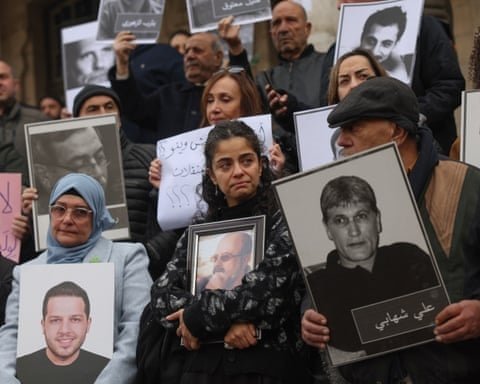
For over a decade, I refused to mourn. My father was taken from our home in July 2013 by state forces, and the silence that followed became our reality. Each day began and ended with the same conviction: he was alive. To grieve without proof felt like an act of surrender, a betrayal of the man we loved.
This state of perpetual uncertainty is a unique form of suffering psychologists identify as “ambiguous loss.” Unlike death, which offers rituals and closure, disappearance offers only questions. Families remain suspended between hope and despair, unable to fully embrace either.
Hope became more than a feeling—it became an obligation. I carried his photograph, joined demonstrations, and spoke publicly in his name. The fight for answers became my life’s purpose, a burden shared by countless Syrian families facing similar voids.
The regime’s collapse in late 2024 brought a moment of collective anticipation. Prison gates opened, and thousands searched for missing relatives. Yet for many, including myself, the search yielded only deeper silence. The absence remained, now compounded by the realization that crucial answers might have vanished behind those same prison walls.
The questions now are more haunting than ever. Was he alone at the end? Did he know we never stopped looking? These uncertainties prevent both closure and moving forward.
This tragedy extends far beyond my family. Documented cases show over 160,000 Syrians have disappeared since 2011, with estimates reaching 180,000 when accounting for all conflict parties. Each number represents a family trapped in the same psychological limbo.
The new authorities must prioritize ending enforced disappearances and unlawful detentions. The recently established National Commission for the Missing represents a critical opportunity, but only if it operates with complete independence and includes families and survivors in leadership roles. Truth and justice must guide this process without exception.
International responses to conflicts in the region have demonstrated that Syrian families cannot rely on external saviors. Our strength comes from within—from the photographs we carry, the stories we preserve, and our collective refusal to be silenced. Justice begins with memory and the unwavering demand that these crimes never recur.
Until every family learns the truth about their missing loved ones, our grief remains incomplete. But our determination to seek justice remains undiminished. The fight continues, not as emotion, but as duty.