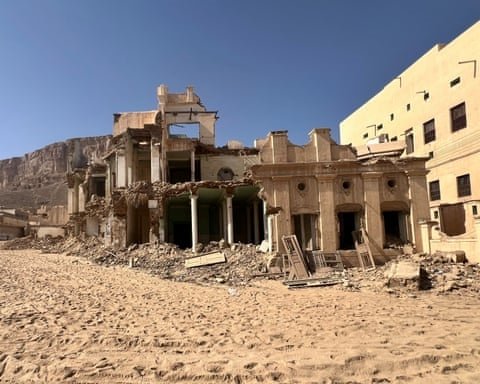
In the ancient city of Tarim, a piece of Yemen’s architectural heritage is quietly disappearing. Bulldozers have recently demolished one of the city’s famed mud-brick palaces, drawing crowds of onlookers who watched in dismay as clouds of dust enveloped a structure that had withstood storms and conflict for generations.
Local journalist Haddad Musaied arrived at the scene after receiving urgent calls, only to document the heartbreaking collapse of Abdul Rahman Bin Sheikh al-Kaf’s historic home. “It was devastating to witness Tarim’s legacy being erased,” Musaied remarked. His footage shows the palace partially in ruins, exposing once-elegant interiors with intricate roofs, white columns, and carved wooden windows.
Built between the two world wars by wealthy merchants from the al-Kaf family, these palaces reflect a unique blend of Yemeni Hadrami design and Southeast Asian influences. Artisans, including builders, painters, and carpenters, contributed to their construction, creating vibrant mansions that have long attracted cultural enthusiasts.
Mohammed al-Kaf, the property’s owner, expressed frustration over the lack of government support for repairs. He cited complaints from neighbors about the building’s precarious condition and fears it might collapse. “The state has failed to assist in preserving this landmark,” al-Kaf stated.
Tarim, recognized as a bastion of Sufi Islam and a historic center for Islamic missionaries, was designated the capital of Islamic culture in 2010 by the Islamic World Educational, Scientific and Cultural Organization. More recently, it was added to Yemen’s UNESCO World Heritage tentative list. Yet, despite its cultural significance, the palaces face an uncertain future.
Years of war have left many of these structures abandoned and decaying. Some have already been replaced by modern concrete buildings, while others, like the Hamtut Palace, show severe erosion and have been partially sold off. Al-Quba Palace, another mud-brick icon, stands scarred and fenced off, its swimming pool empty and walls crumbling.
Ahmed Bahamalah, a representative from Yemen’s General Authority for Antiquities and Museums, acknowledged the dire situation, noting that most of Tarim’s historic mansions are in a dilapidated state. However, with government bodies facing severe financial constraints, there are no resources available for restoration efforts. “We are doing what we can by reporting to higher authorities and seeking assistance,” Bahamalah explained.
As these architectural treasures vanish, residents and cultural advocates warn that the loss extends beyond bricks and mortar—it signifies the erasure of a rich historical narrative that the world may never fully appreciate.