
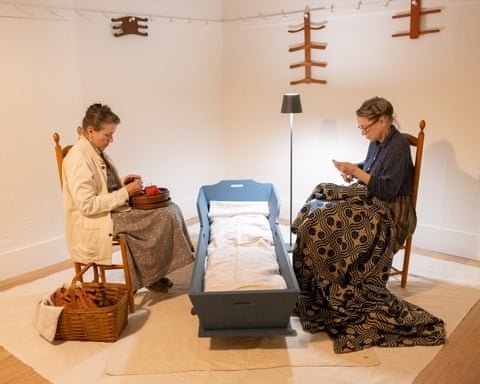
An innovative art installation in Los Angeles is drawing attention to the unique end-of-life practices of the Shakers, a historic religious community. The project, created in collaboration with actress Frances McDormand and conceptual artist Suzanne Bocanegra, centers on the use of adult-sized cradles, recontextualizing them as objects of comfort and community care.
The exhibition, titled “Cradled,” presents four authentic Shaker cradles sourced from museums across the United States. These artifacts are displayed alongside rocking chairs and baskets containing mending materials, inviting visitors to engage in the Shaker practice of repair—both literal and symbolic.
McDormand explained her attraction to the concept, noting how the adult cradle challenges conventional associations. “The scale and purpose of these objects is thought-provoking,” she said. “They represent care for the elderly and infirm, shifting our understanding of what a cradle can be.”
Historical records indicate the Shakers, known for their celibate lifestyle and emphasis on communal living, developed sophisticated systems for elder care. The rocking motion of these cradles served both practical and emotional purposes—preventing pressure sores in bedridden individuals while providing comfort through rhythmic movement.
According to specialists familiar with Shaker traditions, the cradles facilitated meaningful connection between caregiver and recipient. “This was never a solitary activity,” noted one collections expert. “The person rocking and the person being rocked both had purpose in that relationship. No one was left to face illness or death alone.”
The installation creates an immersive environment featuring an original musical composition adapted from Shaker spiritual texts about eternal life. The artists emphasize this is an experiential rather than performative space, encouraging visitors to sit, reflect, and engage with the themes at their own pace.
Beyond the cradles, the exhibition highlights other aspects of Shaker culture, including their philosophy of simplicity and functional craftsmanship. “Their approach wasn’t about minimalism for its own sake,” McDormand observed. “It was about singleness of purpose—creating objects of utility that naturally achieved beauty through their thoughtful design.”
The Shakers, who originated in 18th century England before establishing communities in America, maintained self-sufficient societies for over two centuries through various enterprises including furniture making and agricultural innovation. Archival materials in the exhibition even reveal a 1960s Barbie doll dressed in Shaker clothing, demonstrating the community’s unexpected engagement with contemporary culture.
“Cradled” continues through early January, offering a contemplative space to consider historical approaches to community, care, and the universal human need for comfort across the lifespan.