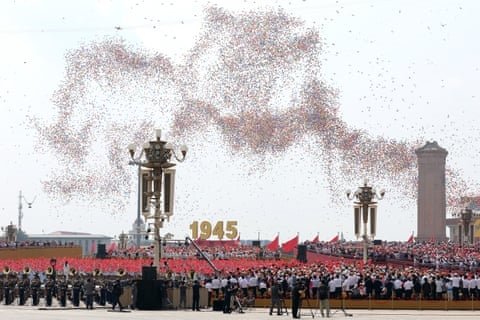
Beijing staged a massive military parade to commemorate the 80th anniversary of the end of World War II, an event that served as a powerful platform for both displaying advanced weaponry and solidifying a strategic partnership between China, Russia, and North Korea.
The visual centerpiece of the day was the sight of Chinese President Xi Jinping walking to the parade grounds flanked by Russian President Vladimir Putin and North Korean leader Kim Jong-un. The image, broadcast widely, projected a unified front of three powers increasingly at odds with Western nations. The gathering was notably absent of leaders from major Western countries, with attendance dominated by nations friendly to Moscow and Beijing, such as Serbia, Slovakia, Myanmar, and Iran.
From a podium in Tiananmen Square, President Xi addressed the crowds, framing the current global situation as a choice between “peace and war.” He asserted that China is “never intimidated by any bullies” and is “on the right side of history,” while pledging to safeguard the nation’s “sovereignty, unity, and territorial integrity”—a statement widely interpreted as a reaffirmation of Beijing’s claim over Taiwan.
The parade itself was a sweeping exhibition of China’s rapidly modernizing military, the People’s Liberation Army. Analysts noted several key developments, pointing to lessons learned from contemporary conflicts. A significant focus was on counter-drone technology and airborne early warning aircraft, systems seen as critical in modern warfare.
The display of missile capabilities underscored efforts to build a robust “nuclear triad”—the ability to launch nuclear weapons from land, air, and sea. While China has long maintained silo-based intercontinental ballistic missiles (ICBMs), analysts highlighted advancements in more survivable systems. These include bombers capable of launching missiles from the air and, notably, the new JL-3 submarine-launched ballistic missile, which can be fired with minimal warning from stealthy submarines.
Military observers stated that the parade signaled a shift in China’s nuclear posture, moving beyond a “minimum deterrent” to a larger, more sophisticated arsenal intended to match other global powers. The event also featured flyovers by advanced fighter jets, including the J-20 stealth fighter and H-6 bombers, alongside new hypersonic missiles designed to be highly mobile and difficult to intercept.
The presence of Kim Jong-un’s daughter, Kim Ju-ae, marked her international debut and fueled speculation about her future role in the North Korean leadership. The event concluded with a symbolic release of 80,000 doves into the sky above Beijing.