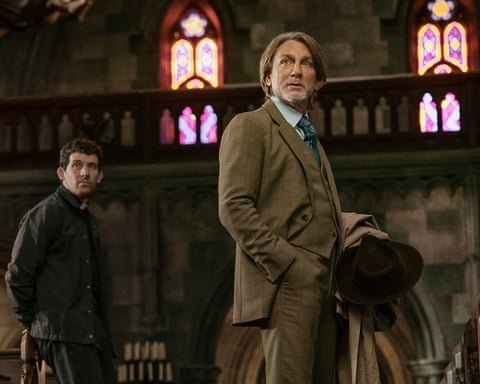
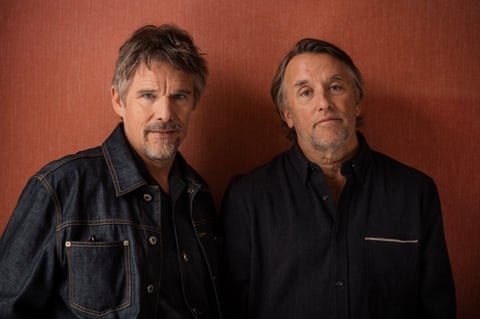
In a London hotel suite, actor Ethan Hawke and director Richard Linklater settle into a conversation that feels both familiar and profound. The pair, now collaborating on their eleventh film together, discuss the challenges and rewards of their latest project, a period drama set in 1940s Broadway.
Their creative partnership, which began over three decades ago, has evolved through films that mirror their own life stages—from the youthful idealism of “Before Sunrise” to the more introspective themes of their recent work. Their newest film, “Blue Moon,” represents a departure from their usual dynamic, pushing Hawke into a role that demanded a significant physical and emotional transformation.
Hawke portrays Lorenz Hart, a gifted but troubled lyricist grappling with personal and professional turmoil. To embody Hart, who was bald and stood just five feet tall, Hawke shaved his head and used creative camera techniques to alter his height. The experience, he notes, offered a stark perspective on societal biases. “The world is heightist,” Hawke observes. “It’s ingrained in our culture and language. When people don’t want to flirt with you, it changes how you see yourself.”
The role pushed Hawke beyond his comfort zone, requiring what he describes as “hitting the wall of my talent.” Linklater, however, sees such moments as essential. “That’s the place where you want to be,” the director remarks, emphasizing the value of creative risk.
Their collaboration has endured in an industry known for its volatility. Both attribute the longevity of their partnership to a shared disregard for conventional markers of success. “We both percolate,” Linklater says. “Our underachieving careers have served us well.” Hawke adds that their mutual independence has kept the relationship balanced, free from the pressures of status or favor.
The conversation turns to the broader themes of addiction and loss, informed by their experiences in the industry. Hawke reflects on colleagues like Philip Seymour Hoffman, whose struggles with addiction ended in tragedy. “Phil had a problem. He lost one day,” Hawke says. “But he won all the other days for over twenty years.”
As they look ahead, both express a commitment to maintaining their curiosity and idealism. “There are directors of Rick’s age who would lose interest in working this hard,” Hawke notes. “But he never equated success with money. It’s about making good art.”
For Hawke and Linklater, the conversation—and the collaboration—continues.