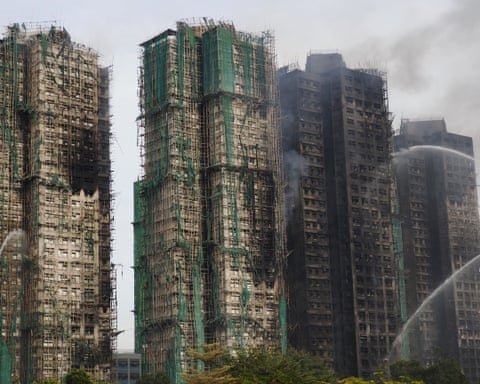
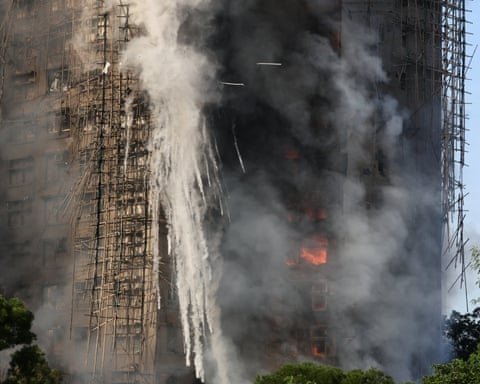
A devastating fire that swept through a residential complex in Hong Kong, resulting in numerous fatalities, appears to have been accelerated by the presence of traditional bamboo scaffolding encasing the buildings. The incident marks one of the most severe fire tragedies in the city in recent decades.
The blaze erupted at the Wang Fuk Court apartment complex in the Tai Po district, a development consisting of eight 31-story towers housing thousands of residents. While the official cause remains under investigation, preliminary reports from authorities indicate that the bamboo framework and associated construction netting likely acted as a conduit, enabling the flames to spread rapidly between floors and across the building’s exterior.
Hong Kong stands as one of the few global metropolises where bamboo remains a common material in construction. These intricate networks of poles, lashed together, form a familiar silhouette against the city’s modern skyline. Valued for its light weight, flexibility, and cost-effectiveness compared to metal, bamboo scaffolding is also deeply rooted in regional tradition, with a history stretching back centuries.
However, this tradition is now under scrutiny. Citing safety concerns, the Hong Kong government had previously announced plans to phase out bamboo in favor of fire-resistant steel scaffolding on public works projects. Beyond flammability, metal structures are considered more durable in the city’s humid subtropical climate. Official data has also linked bamboo scaffolding to several fatal industrial accidents in recent years.
The proposed transition has been met with resistance from skilled tradespeople. Bamboo scaffolders, whose expertise lies in manually assembling the naturally varying poles, argue that their specialized craft is an art form and fear for their livelihoods if the material is abandoned. The recent tragedy, however, has intensified the debate over balancing cultural heritage with modern safety standards in one of the world’s most densely populated cities.